All Medicare-eligible consultations are bulk billed for patients with a valid Medicare card. Some items, including privately purchased vaccines and consumables, attract a fee.
Skin checks are among the least uncomfortable appointments there are, and the one most often postponed. Tap each one.
Four things worth knowing
A single spot examined takes minutes and only needs a standard appointment. People routinely wait months for their scheduled full check while carrying around something that worried them in March. That's the wrong way round.
“I've noticed a spot I'd like looked at.”Skin cancers occur on faces, and melanoma occurs under nails — rarely, but it does, and it's easily missed when it's covered. Come bare-faced and bare-nailed and the check is genuinely more useful.
“I've left my makeup off so you can see properly.”A full skin check means undressing to your underwear. There's a gown, a curtain and time to change in private, and you can ask for another staff member in the room, keep items on, or stop. Just say the word.
“Could someone else be in the room, please?”Backs, shoulders and scalps are where you can't see and where a lot of damage lands. If someone else has pointed something out, that's valuable information — mention it at the start rather than hoping we find it.
“My wife noticed something on my back.”Sun damage accumulates from childhood but shows up decades later. Tap through to see what's worth doing at your age.
Open any topic for the short version first, with the detail underneath it.
Full skin check
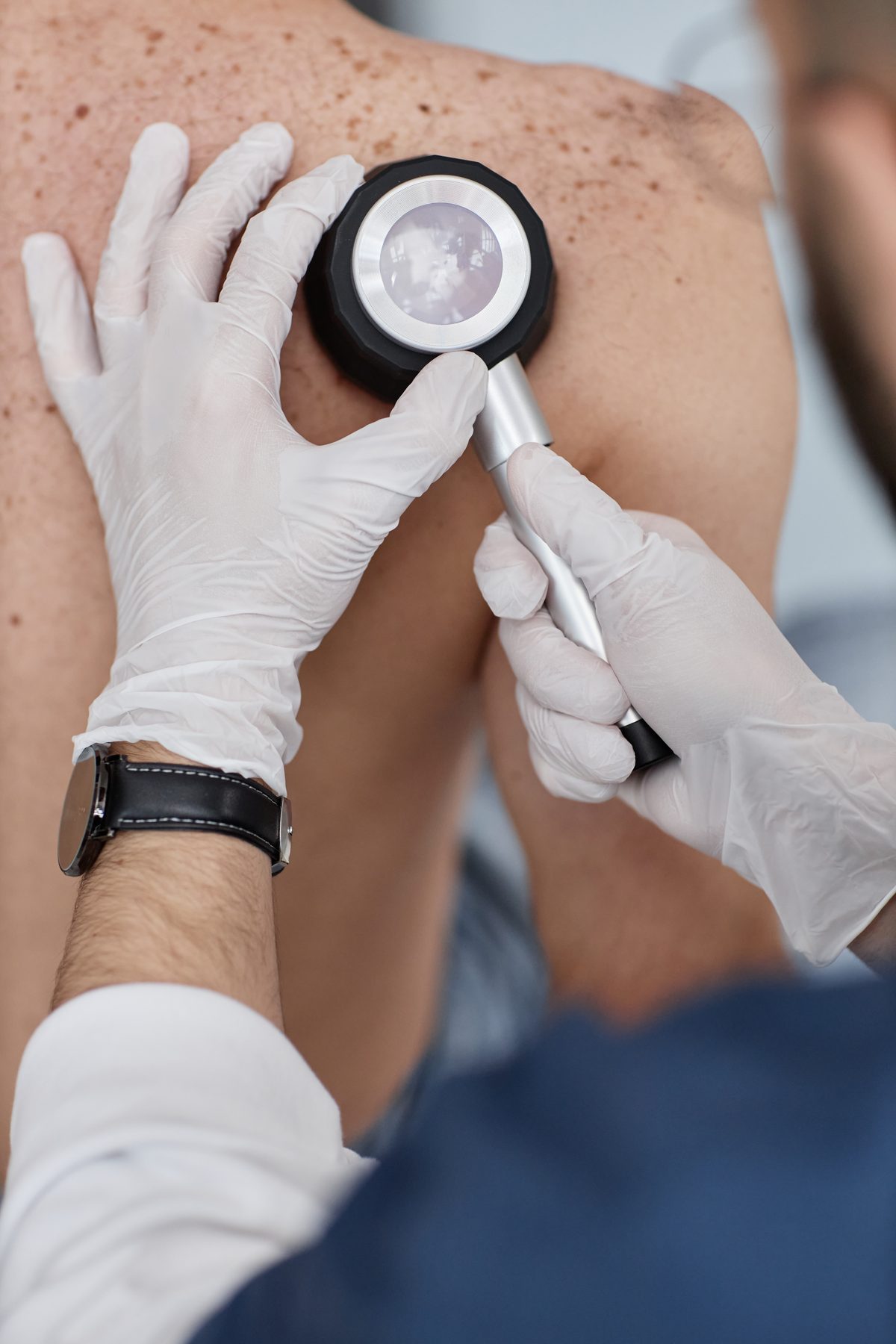
What happens You undress to your underwear and your GP examines your skin from scalp to soles with a dermatoscope — a magnifier with a light that sees structures under the surface. It takes around fifteen minutes and nothing is removed without discussing it first.
Your GP looks at everything, including the places you can't: your back, your scalp, behind your ears, the soles of your feet and between your toes. Anything worth watching is photographed and measured so next year's check has something to compare against.
You can ask for a chaperone in the room at any time, ask to keep items of clothing on, or ask to stop. Tell your GP first about any spot you're specifically worried about — patient concern is a genuinely useful signal.
What to look for
The short version Three things are worth acting on: a spot that's new, a spot that's changing, and a spot that looks different from all your others. You don't need to memorise anything more complicated than that.
Don't wait for your annual check if you've noticed something. Book a short appointment for that one spot — it takes minutes and it's the right thing to do.
The ABCDE guide is useful for moles: Asymmetry, an irregular Border, more than one Colour, a Diameter over about 6mm, and Evolving — changing in any way. But not every skin cancer is a mole, and some of the most dangerous are the ones that don't fit the pattern.
Also worth booking for: a sore that won't heal after a month, a spot that bleeds or itches persistently, a scaly patch that keeps coming back, or a lump that's growing. And anything your partner has noticed on your back.
Procedures
What's involved Local anaesthetic, so the area is numb. You're awake and comfortable throughout. Small lesions are removed in a single visit; larger ones are booked as a longer appointment.
A biopsy takes a sample to find out what something is. An excision removes the lesion entirely with a margin of normal skin around it. Which one is right depends on the lesion, where it is and what your GP suspects.
Several of our GPs perform both simple and more complex excisions on site, including flaps and grafts where needed. Everything removed goes to pathology, and we contact you with the result either way.
Sunspots
Worth knowing Those rough, scaly patches on your face, scalp, forearms and hands are actinic keratoses — sun damage that has started to change. A small proportion go on to become skin cancers, which is why they're treated.
Cryotherapy uses liquid nitrogen to freeze the lesion. It stings briefly, blisters over a few days and heals within a couple of weeks. Multiple spots can be done in one visit.
Where there are a lot of them across an area, a prescription cream used over several weeks can treat the whole field at once. Your GP will explain what to expect, because the treated skin looks worse before it looks better.
Melanoma
The short version Melanoma is the skin cancer that can spread, which is why the emphasis is so heavily on finding it early. Found early and removed, the outlook is very good indeed.
It can appear anywhere, including places that never see the sun, and it doesn't always start in an existing mole — more often than not it's a new spot. It can also be pink or skin-coloured rather than dark.
If your GP is suspicious, the lesion is removed promptly and sent for pathology. If melanoma is confirmed you'll be referred for definitive treatment, and your GP stays involved in your ongoing surveillance afterwards.
BCC & SCC
Worth knowing These are far more common than melanoma and behave differently — they grow locally rather than spreading, so they're treated thoroughly but rarely urgently. Most Australians who get a skin cancer get one of these.
Basal cell carcinomas are often a pearly bump, a patch that bleeds and scabs repeatedly, or a scar-like area that wasn't caused by an injury. Squamous cell carcinomas are more often firm, scaly, tender and faster growing.
Both are usually treated successfully by removing them completely. Left alone they keep growing locally and become harder to fix, which is the argument for dealing with them early rather than any urgency about spread.
How often
Straight answer It depends on your own risk. Some people need a check every year, some every six months, and some only when they notice something. Your GP works it out with you rather than applying a blanket rule.
Things that push the interval shorter: fair skin that burns easily, a lot of moles, unusual moles, a personal or family history of skin cancer or melanoma, an outdoor job, solariums, significant sunburns, or a weakened immune system.
Whatever the interval, the most valuable thing remains your own attention between visits. Most skin cancers are found by the person they belong to, or their partner.
Prevention
Realistic version Nobody's suggesting you stay indoors in Port Stephens. It's about the few hours either side of midday, and about the days you don't think of as sunny — overcast, windy days on the water are exactly when people get caught.
Sunscreen works, but only in the amounts nobody uses: roughly a teaspoon for your face and neck, reapplied every two hours and after swimming. Shade, a hat and a shirt do more heavy lifting than sunscreen alone.
Vitamin D is a fair question in this conversation, and your GP can check your level rather than either of you guessing.
People often book the wrong one and either feel rushed or take a long appointment they didn't need. Here's the difference, so you can ask for the right thing. Tap a card.
One thing worrying you, looked at properly. Short, focused, and available quickly.
Everything examined, head to toe, with anything worth watching photographed and recorded.
General information only. How often you should be checked depends on your own skin, history and risk — your GP will work that out with you.
Nothing about this is painful and nothing is removed without discussing it with you first. Here's the whole appointment, in order.
Don't wear makeup or nail polish, and take note of anything you specifically want looked at. If your partner has spotted something on your back, bring that up first.
Flip backYour GP asks about sunburns, outdoor work, solariums, family history and any previous skin cancers. It shapes how closely everything gets examined.
Flip backThere's a gown, a curtain and time to undress in private. You can ask for a chaperone, keep items on, or stop at any point.
Flip backA magnifier with a polarised light that sees structures beneath the surface. It's what turns a guess into an assessment, and it doesn't touch you painfully at all.
Flip backIncluding your scalp, behind your ears, between your toes and the soles of your feet. Skin cancers turn up in places that never see the sun.
Flip backMeasured and recorded, so next year's check compares rather than starts again. Change over time is the single most useful signal there is.
Flip backOften the same day. Local anaesthetic, a biopsy or excision, a dressing, and everything removed goes to pathology.
Flip backWhether that's six months, a year, or come back if you notice something. Results are phoned through either way, not only if something's found.
Flip backTap whatever applies and print the list to bring with you. Pointing at the right spot beats trying to describe it, and your own concern is genuinely useful information.
Several of our GPs perform both simple and more complex skin excisions on site, so most procedures happen here rather than somewhere else on another day.
Our GPs hold general registration with AHPRA. Areas listed are special interests within general practice rather than recognised specialist registration. Where a dermatologist or plastic surgeon is the right route, your GP will refer you.
Pick your situation and what you're coming in for. We'll show you what to expect before you book.
What are you coming in for?
Figures shown are what you pay at the clinic for the appointment itself. Medicines, devices, imaging and specialist fees are set elsewhere. Reception will always confirm the cost with you before anything goes ahead.
Yes. Full skin checks and spot checks are bulk billed for patients with a valid Medicare card, and most biopsies and excisions are Medicare items too. Some consumables may attract a small fee, and cosmetic removals aren't covered — reception will always tell you before anything goes ahead.
It depends on your own risk. Fair skin, many moles, previous skin cancers, a family history of melanoma, outdoor work or significant sunburns all mean more frequent checks. Your GP will give you a specific recommendation rather than a blanket rule.
Around fifteen minutes of examination, so book a long appointment. A single spot check is much quicker and only needs a standard appointment.
For a full skin check, down to your underwear — skin cancers occur on parts of the body that never see the sun. There's a gown, privacy to change, and you can ask for a chaperone, keep items on, or stop at any point.
A hand-held magnifier with a polarised light that lets your GP see structures beneath the surface of the skin. It's non-invasive, it doesn't involve radiation, and it's what makes the difference between a guess and an assessment.
Often, yes. Small lesions can usually be biopsied or excised during the same visit under local anaesthetic. Larger or more complex ones are booked as a longer appointment, usually soon after.
Any excision leaves a scar. Your GP will explain what to expect for that particular spot and location before you agree to anything, and will talk through the trade-off honestly, especially on the face.
Pathology usually takes about a week. We contact you either way — not only when something is found — and book a follow-up appointment if one is needed.
You'll need more frequent checks, and your immediate family should be checked too since their risk is higher. Your GP will set up a surveillance schedule and stay involved alongside any specialist care.
Yes, but purely cosmetic removal isn't a Medicare item, so it's charged privately. If there's any clinical concern about the lesion, that changes and it's covered. Reception will quote it beforehand, and your GP will be honest about scarring.

If you've been carrying around a spot you keep meaning to get looked at, book the appointment. It's almost always nothing, and finding that out takes minutes.
A full skin check with a dermatoscope takes around fifteen minutes, and spot checks are a short appointment. Suspicious spots can often be biopsied or removed in our rooms, and sunspots treated with cryotherapy.
The clinic is inside Salamander Bay Shopping Centre at Shop 5, 2 Town Centre Circuit, with free parking, and is a short drive from Nelson Bay, Corlette, Soldiers Point, Anna Bay, Shoal Bay, Fingal Bay and Medowie.
Book online with HotDoc at any hour, or call (02) 4008 4400.
From the health journal

